 ultimate-guide
Best Ways to Recover From Sports Injuries
Last Updated: November 1, 2026
Quick Summary
The best ways to recover from sports injuries start in the first 48 hours with rest, ice, compression, and elevation to control swelling, then progress through controlled movement, gentle strengthening, and sport-specific loading. Sleep, protein-rich nutrition, hydration, and objective clearance criteria guide a safe return to sport.
- Use R.I.C.E. for the acute phase only, since prolonged rest can stiffen a joint.
- The subacute phase, days 3 to 14, restores range of motion and begins gentle strengthening.
- Aim for seven to nine hours of sleep, when tissue repair peaks.
- Advance through five return-to-sport steps, clearing each before the next.
- Keep pain at or below 2 out of 10 during and after loading.
Table of Contents
- Sports Injury First Aid: What to Do in the First 48 Hours
- Your Sports Injury Recovery Timeline, Phase by Phase
- Active Recovery Techniques That Support Tissue Healing
- Sleep, Nutrition, and Hydration for Faster Healing
- Mental Recovery After a Sports Injury
- Return to Sport After Injury: A Phased Approach
- Book Your Recovery Assessment
- Frequently Asked Questions
Sports Injury First Aid: What to Do in the First 48 Hours
The best ways to recover from sports injuries start in the first 48 hours, before swelling peaks and before the tissue decides how angry it will get.
According to Johns Hopkins Medicine, roughly 21 percent of all traumatic brain injuries among children come from sports and recreational activities, and nearly half of all sports head injuries involve youth athletes.
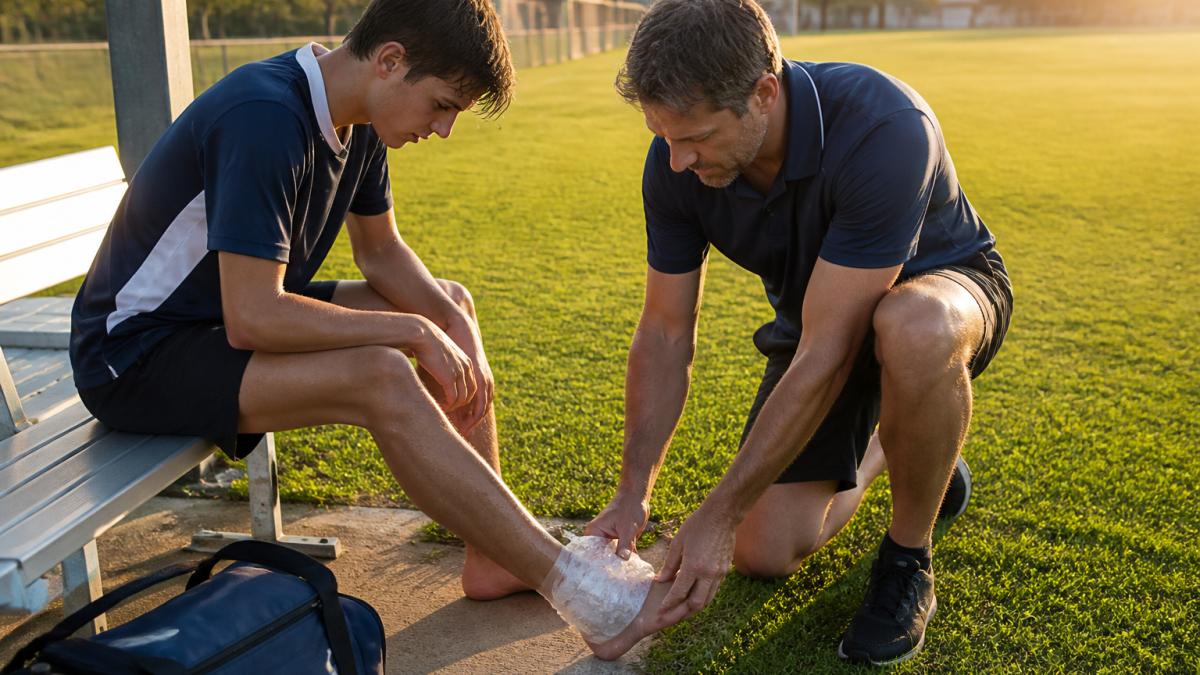
The R.I.C.E. Method and Its Limits
Rest, ice, compression, and elevation remain the standard first response for mild injuries. The Cleveland Clinic still lists R.I.C.E. as the go-to approach for immediate relief of minor sports injuries.
Its limits matter. Ice manages pain and swelling, but it does not repair tissue, and prolonged rest can stiffen a joint. Use R.I.C.E. to control the acute phase, then move on.
Your Sports Injury Recovery Timeline, Phase by Phase
A sports injury recovery timeline has three broad phases: protection and inflammation control in the first 48 to 72 hours, controlled movement and tissue healing over the following weeks, and a gradual return to sport-specific loading. Timelines vary by injury type and severity, so treat any general schedule as a guide, not a promise. Integrating alternative recovery options into these phases can help manage systemic fatigue and support the body's natural repair processes as you transition back to full activity.
- Acute phase (0-72 hours): protect the area, manage swelling, avoid painful loading.
- Subacute phase (days 3 to 14): restore range of motion and begin gentle strengthening.
- Remodeling phase (weeks 2-8): progressive loading, cross-training, sport-specific drills.
- Return phase: phased reintroduction of full training with load management.
Injury-Specific Timelines: What Most Guides Skip
General phase charts are everywhere. What athletes actually want to know is how long their injury takes. Here is a practical breakdown for four of the most common sports injuries, drawn from widely published clinical guidance and the patterns most practitioners see in practice. These are typical ranges for otherwise healthy adults, not guarantees.
| Injury | Typical Return Window | Key Milestone Before Advancing |
|---|---|---|
| Ankle sprain (grade I-II) | 2-6 weeks | Pain-free single-leg hop and full weight-bearing without swelling |
| Hamstring strain (grade I-II) | 3-8 weeks | Pain-free sprinting at 80% effort |
| Rotator cuff strain | 4-12 weeks | Full overhead range of motion without pain |
| ACL reconstruction | 9-12 months | Cleared strength symmetry and sport-specific testing |
A few patterns matter more than the exact numbers:
- Grade matters more than injury name. A grade I ankle sprain and a grade III ankle sprain share a name but not a timeline. Get the grade confirmed before you set expectations.
- The last 20% takes the longest. Most athletes feel "fine" well before the tissue is ready for full load. The final stage of remodeling is where re-injury risk concentrates.
- Re-injury resets the clock, and often adds to it. A hamstring re-injured mid-rehab commonly takes longer to resolve than the original strain did.
How to Tell You Are Actually Progressing
Calendar time is a weak signal. Better markers are objective and easy to track at home:
- Swelling that stays down after activity rather than returning hours later
- Range of motion that matches the uninjured side within a few degrees
- Pain that stays at or below a 2 out of 10 during and after loading
- Strength that holds up across repeated sets without a drop-off
If any of those regress after a session, you advanced too fast. Back off one step, hold for a few days, and re-test. That single habit prevents more setbacks than any gadget you can buy.
Active Recovery Techniques That Support Tissue Healing
Active recovery means gentle movement that increases blood flow without re-injuring tissue. Research published through the National Institutes of Health found that personalized rehabilitation programs combining strength training, flexibility exercises, and sport-specific drills are effective for recovery. The Gatorade Sports Science Institute notes that athletes commonly use hydrotherapy, active recovery, stretching, compression garments, and massage.
Common techniques we see work well:
- Low-intensity cycling or pool walking to move fluid without impact
- Contrast hydrotherapy alternating warm and cool water
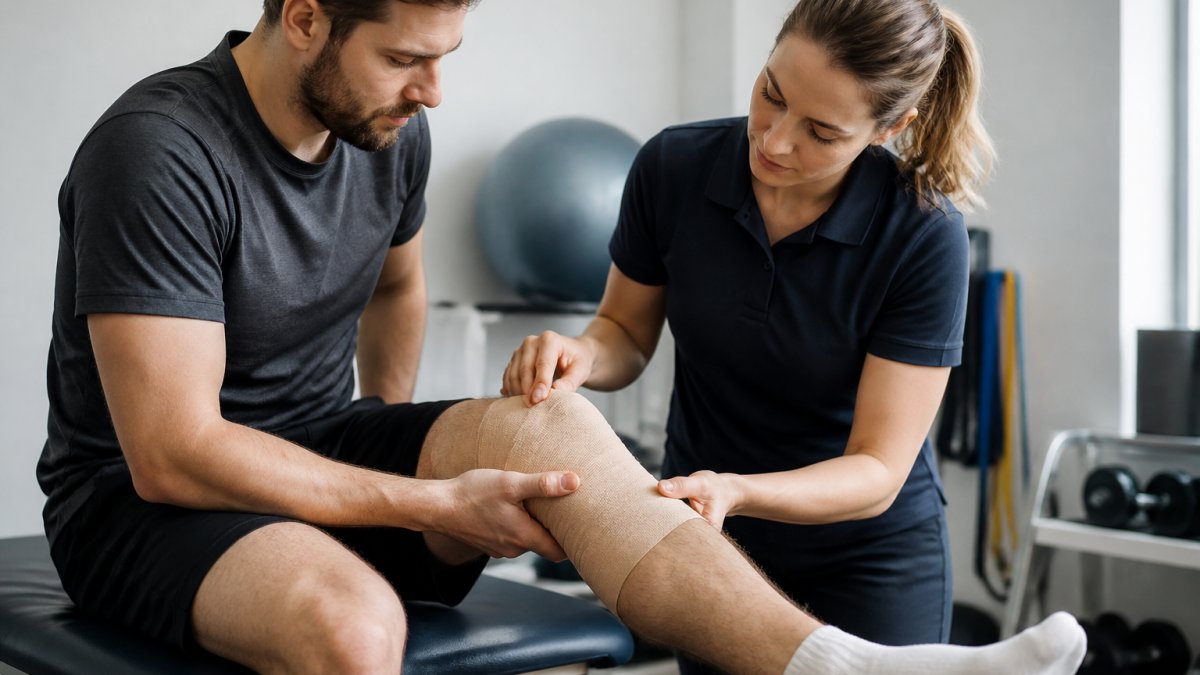
- Compression garments to manage swelling during activity
- Manual techniques such as soft tissue work and joint mobilization
Sports chiropractic care focuses on restoring joint mechanics and supporting the tissue's own healing response.
Tools for Home Recovery: Compression, Ice, and Stimulation
Home tools help, provided you use them for the right job. A reusable gel pack handles acute swelling; a compression system or brace manages load and fluid; a percussion device loosens surrounding muscle.
| Tool | Best For | Typical Price | Watch Out For |
|---|---|---|---|
| TheraPearl Sports Pack | Acute hot/cold therapy | $14.99 | 20-minute temperature limit |
| KT Tape Pro | Lightweight joint support | $19.99 | Needs correct application |
| TriggerPoint GRID Foam Roller | Self-myofascial release | $39.99 | Can be uncomfortable at first |
| Hyperice Hypervolt 2 | Portable muscle tension relief | $129.00 | Manual operation |
| Bauerfeind GenuTrain Knee Brace | Joint stability during recovery | $129.99 | Higher price point |
| Breg Polar Care Cube | Extended icing after acute injury | $185.00 | Needs power and ice |
| Compex Edge 2.0 | Electrical muscle stimulation | $299.99 | Replacement electrodes |
| Normatec 3 Legs | Automated compression therapy | $799.00 | Significant investment |
Sleep, Nutrition, and Hydration for Faster Healing
Sleep is when tissue repair actually happens. Growth hormone release, protein synthesis, and immune support all peak during deep sleep, which is why athletes who sleep poorly heal slowly.
Nutrition supports tissue healing through adequate protein, enough calories, and micronutrients involved in repair. Hydration matters too: dehydration impairs circulation and slows the delivery of nutrients to injured tissue. Learn more about the health benefits of proper hydration.
Mental Recovery After a Sports Injury
Being sidelined is a psychological event, not just a physical one. Research from the University of California, Santa Barbara highlights positive self-talk, imagery, and goal setting as effective methods for managing the mental challenges of injury.
- Set process goals you can hit while injured, such as range-of-motion targets.
- Imagery can be used to rehearse movement patterns you cannot yet perform.
- Keep a written log so progress is visible on flat days.
Athletes who address the mental side tend to follow their rehab plan more consistently. That consistency is what actually drives outcomes.
Return to Sport After Injury: A Phased Approach
Return to sport is a progression, not a decision made in one appointment. The CDC recommends a phased approach that starts with light aerobic activity and advances to heavy non-contact drills before full contact.
A workable sequence looks like this:
- Light aerobic activity with no symptoms
- Sport-specific movement at moderate effort
- Non-contact drills at full speed
- Full-contact practice
- Competition
Each step should be cleared before the next. Explore chiropractic rehabilitation services that guide a safe phased comeback. Watch out: skipping straight from pain-free walking to full practice is the most common cause of re-injury.
Objective Clearance Criteria, Not Just Feelings
"It feels better" is the most common reason athletes return too soon. The problem is that pain often disappears before tissue is ready for full load. Use measurable criteria at each step instead:
- Symmetry: strength and range of motion within about 10% of the uninjured side
- Load tolerance: completing a full training session with no increase in swelling or soreness the next day
- Sport-specific testing: sprinting, cutting, jumping, or throwing at full effort without guarding or hesitation
- Confidence: you can perform the movement without bracing or mentally rehearsing it first
A simple home test for lower-body injuries is the single-leg hop for distance. Compare the injured side to the healthy side. A gap of more than about 10% is a signal to keep building strength before advancing.
Why Re-Injury Happens and How to Prevent It
Re-injury is rarely bad luck. A few mechanisms account for most of it:
- Returning before strength symmetry is restored. The tissue healed, but it did not rebuild its capacity to absorb load.
- Skipping the non-contact phase. Athletes jump from jogging to full practice because the middle steps feel tedious.
- Fatigue exposure. Many re-injuries happen late in a session or match, when form degrades. Practice sport-specific movements under mild fatigue before competition.
- Ignoring the warning signs. Increased swelling, a return of pain, or a feeling of instability after a session means you advanced too fast.
Cross-Training While You Wait
You do not have to be idle between phases. Cross-training keeps fitness up without loading the injured tissue:
- Pool running or swimming for cardiovascular work with minimal impact
- Stationary cycling for lower-body injuries that tolerate bending
- Upper-body or core work for lower-body injuries, and vice versa
- Skill work at low intensity to keep movement patterns sharp
Keep cross-training sessions below the threshold that causes next-day swelling. If it does, you went too hard, not too long.
Book Your Recovery Assessment
Recovering from a sports injury is a sequence of decisions, and the first one matters most: getting an accurate assessment before you load the tissue again. Family Chiropractic Plus offers chiropractic care, massage therapy, and comprehensive care under one roof, with over 23 years of international and domestic practice experience and a 15% discount for first responders and active or retired military. Dr. Martin Blankenship, DC, and Dr. Get started with Family Chiropractic Plus and book your appointment to begin your recovery assessment.
Frequently Asked Questions
What is the best way to recover from a sports injury?
Start with immediate protection: rest, ice, compression, and elevation for the first 24 to 48 hours, as the Cleveland Clinic still recommends for mild injuries. Then move into a phased plan. Research from the National Institutes of Health shows personalized programs combining strength training, flexibility work, and sport-specific drills support recovery. Sleep, nutrition, and psychological support matter too. A qualified clinician can assess the injury and build a plan matched to your sport and healing stage.
How do I know when I can return to sports after an injury?
The CDC recommends a phased return that starts with light aerobic activity and progresses to heavy non-contact drills before full contact. You should be pain-free during daily movement, have full range of motion, and pass sport-specific tests before advancing. Returning too early raises the risk of re-injury. A clinician can confirm each phase is complete rather than relying on how you feel on a given day.
Can sleep and nutrition really help with sports injury recovery?
Yes. Tissue healing depends on adequate protein, calories, and micronutrients, and sleep is when most repair processes happen. Hydration supports circulation and joint function. Treat sleep and food as part of the recovery protocol, not an afterthought.
How can athletes cope mentally while recovering from an injury?
Research from the University of California, Santa Barbara highlights positive self-talk, imagery, and goal setting as effective ways to manage the mental challenges of being sidelined. Set small weekly goals, keep a written log of progress, and stay connected to your team. Mental recovery after a sports injury is a real part of the process, and addressing it helps athletes return with confidence rather than fear of re-injury.
When should I see a doctor for a sports injury?
Seek care promptly for severe pain, visible deformity, inability to bear weight, numbness, or a head injury. Johns Hopkins Medicine notes that about 21 percent of traumatic brain injuries in children come from sports and recreation, so any suspected concussion needs medical review. For persistent swelling or pain that lingers beyond a few days, an evaluation can rule out fractures and guide the next steps.