 how-to
Chiropractic Care for Office Workers' Neck Pain
Table of Contents
- Why Office Workers Develop Neck Pain and Stiffness
- Tech Neck Exercises for Office Workers
- Ergonomic Desk Setup for Neck Pain Prevention
- How Chiropractic Care Addresses Work-Related Neck Pain
- How Long Does Chiropractic Treatment Take for Neck Pain
- When Neck Pain Requires Medical Evaluation
- Building a Sustainable Desk Worker Routine
- Frequently Asked Questions
Last Updated: October 7, 2026
Why Office Workers Develop Neck Pain and Stiffness
Neck pain affects millions of office workers, and chiropractic care for office workers neck pain is one of the most effective solutions. If you spend hours at a desk, you know the feeling: stiffness by mid-afternoon that lingers into evening. Understanding why it happens is the first step toward fixing it.
How prolonged sitting affects the cervical spine
Your cervical spine, the seven bones in your neck, wasn't designed for eight hours of stillness. When you sit without moving, your neck muscles tighten. Your joints stiffen. Blood flow slows.
Prolonged sitting changes your spinal alignment: vertebrae shift, discs compress unevenly, and nerves get irritated. Over weeks and months, the damage compounds.
The real problem isn't one bad day at your desk. It's the repetition: five days a week, forty weeks a year, your cervical spine stays locked in the same position.
Forward-head posture and muscle tension
Forward-head posture is the silent killer for office workers. Your head drifts forward. Your shoulders round inward. Your upper back curves.
This happens gradually, without you noticing, but your muscles notice immediately.
When your head moves forward even two inches, your neck muscles work harder to hold up its ten to twelve pounds, and your trapezius tightens constantly.
The muscle tension creates a cycle. Tight muscles pull your spine out of alignment. Misalignment makes muscles work harder. More tension follows.
Forward-head posture also narrows the space between vertebrae, pinching nerves and causing sharp pain, dull aches, or a burning sensation.
Tech Neck Exercises for Office Workers
Tech neck doesn't have to be permanent. Targeted movements restore range of motion, strengthen the muscles supporting your cervical spine, and interrupt the tension cycle.
The best exercises take two to three minutes at your desk, with no equipment needed.
Stretches to relieve neck strain during the workday
Neck flexion stretch: Sit upright. Drop your chin toward your chest slowly. Feel the stretch along the back of your neck. Hold for twenty seconds. Repeat three times.
Lateral neck stretch: Tilt your right ear toward your right shoulder. Don't force it. Stop when you feel gentle tension. Hold for twenty seconds. Switch sides.
Shoulder rolls: Roll your shoulders backward in slow circles. Five rolls forward. Five rolls backward. This releases tension in your upper back and neck.
Chin tucks: Sit straight. Gently draw your chin back, creating a double chin. Hold for three seconds. Release. Do ten repetitions.
These stretches work best every two hours. Set a phone reminder, and when it goes off, stand up and stretch for two minutes.
Strengthening movements for cervical spine support
Weak neck muscles can't hold your spine in proper alignment. Strengthening exercises build endurance.
Isometric neck strengthening: Place your hand against your head. Push your head into your hand with light pressure. Don't let your head move. Hold for five seconds.
Resistance band exercises: Loop a resistance band around the back of your head. Hold the ends in front of you. Gently pull the band as you push your head back.
Wall angels: Stand with your back against a wall. Raise your arms to shoulder height, bent at the elbow. Slowly slide your arms upward along the wall. Stop when you feel tension.
Do strengthening exercises three to four times per week, resting your muscles a day between sessions.
Ergonomic Desk Setup for Neck Pain Prevention
Your desk setup either supports your spine or fights it. Small adjustments make enormous differences.
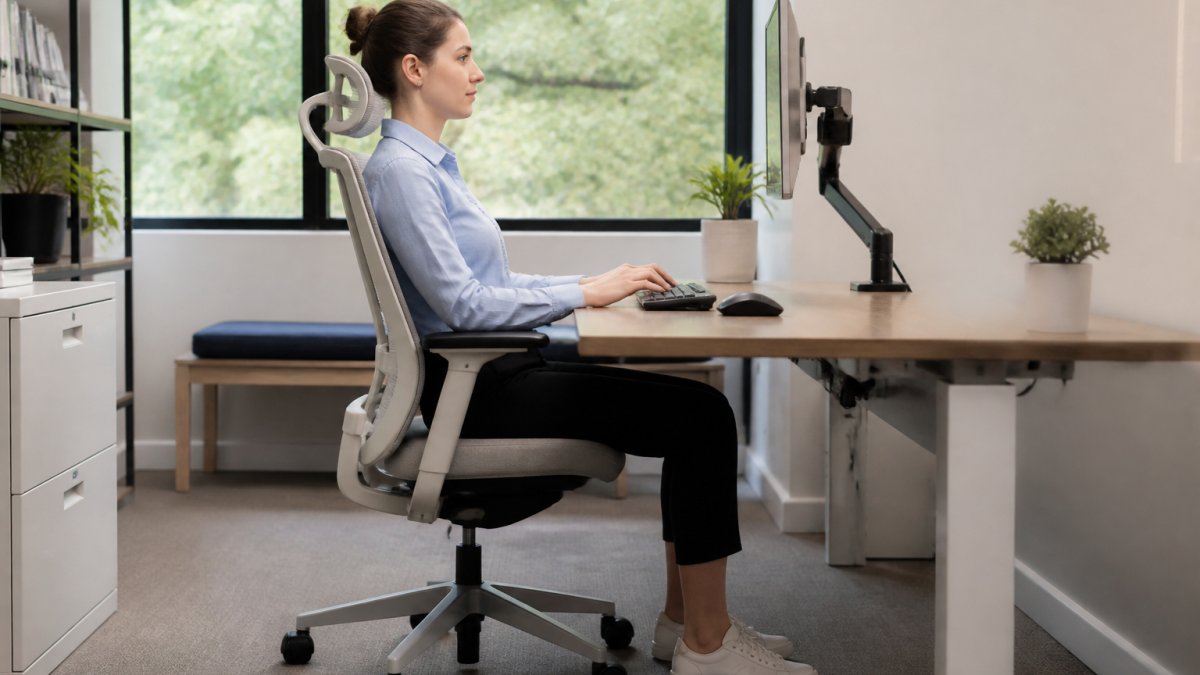
Screen height, keyboard, and monitor positioning
Monitor height: Your screen should be at eye level when you sit upright, with the top of the monitor aligned with your eyes.
Most people sit too low, with monitors six to twelve inches below eye level, forcing constant downward looking.
Monitor distance: Sit an arm's length, about twenty to twenty-six inches, from your screen.
Keep your mouse at the same height as your keyboard and close to your body; reaching far to the side twists your upper back and neck.
Chair height: Your feet should rest flat on the floor with your hips slightly higher than your knees, reducing lower-back pressure and keeping your neck neutral.
Creating movement breaks into your workday routine
Sitting in perfect posture for eight hours is still sitting. Your muscles and joints need movement.
The twenty-minute rule: Every twenty minutes, stand up for one minute. Walk around. Stretch. This breaks the static position cycle.
Hourly movement breaks: Every hour, take a five-minute break. Walk to another room. Climb stairs. Do some neck exercises.
Lunch away from your desk: Don't eat at your desk. Walk outside. Move your neck and spine through different ranges of motion.
End-of-day routine: Before leaving work, spend three minutes on the neck stretches above and shoulder rolls, so your muscles don't stay tight all evening.
Movement breaks aren't wasted time. They improve focus, reduce fatigue, and prevent the damage that leads to chronic neck pain.
How Chiropractic Care Addresses Work-Related Neck Pain
Chiropractic care for office workers neck issues addresses the root cause, spinal misalignment, rather than just the symptoms.
Spinal alignment and chiropractic adjustments
Spinal alignment means your vertebrae sit correctly in relation to the bones above and below, so nerves flow freely and muscles work efficiently.
When your cervical spine misaligns, chiropractic adjustments gently move vertebrae back into position, relieving nerve pressure, reducing muscle tension, and restoring normal movement patterns.
The adjustment is precise: a chiropractor applies controlled, gentle force to specific vertebrae. Most patients feel relief immediately; some over several visits.
At Family Chiropractic Plus, we use personalized treatment plans. We spend time understanding your specific misalignment. We develop a plan tailored to your needs.
Beyond adjustments: complementary treatment approaches
Adjustments are powerful, but complementary approaches address other aspects of your neck pain.
Massage therapy releases muscle tension. Tight muscles pull your spine out of alignment. Massage breaks this cycle. It improves blood flow. It helps muscles relax.
Physical therapy strengthens weak muscles, improves range of motion, and teaches movement patterns that support spinal health.
Nutritional counseling reduces inflammation and supports bone and joint health, speeding recovery.
Postural training teaches you to sit, stand, and move correctly, building habits that prevent future problems.
The best treatment plan combines multiple approaches. Adjustments fix misalignment. Exercises strengthen support muscles. Ergonomic changes prevent re-injury. Together, these create lasting improvement.
How Long Does Chiropractic Treatment Take for Neck Pain
The timeline depends on how long your problem has existed and how severe it is. Acute pain from a recent injury improves faster than chronic pain built over years.
Patients often experience noticeable pain reduction, but complete healing takes longer.
A treatment plan may involve initial frequent visits, decreasing over time for maintenance.
Some patients need longer. Chronic neck pain present for years takes more time, because muscles have adapted to the wrong position and retraining them takes patience.
Patients often report less pain, better sleep, and more energy, early wins that can help maintain motivation.
When Neck Pain Requires Medical Evaluation
Not all neck pain is simple muscle tension. Some symptoms signal serious problems needing medical attention.
Seek immediate medical care if you experience:
- Severe pain that started suddenly after an accident or fall
- Numbness or tingling in your arms or hands
- Weakness in your arms or hands
- Loss of bladder or bowel control
- Fever combined with neck stiffness
- Difficulty swallowing or speaking
- Severe headaches with neck stiffness
Schedule a doctor's appointment if you have:
- Neck pain that doesn't improve after two weeks of self-care
- Pain that radiates down your arm or into your shoulder
- Persistent headaches
- Pain that wakes you at night
- Neck pain after a car accident or significant injury
These symptoms might indicate nerve damage, infection, or structural problems requiring medical diagnosis, so a doctor or emergency room visit is appropriate.
Chiropractic care works well for muscle tension and misalignment but isn't appropriate for infections, nerve damage, or fractures. A qualified healthcare provider can determine which care you need.
At Family Chiropractic Plus, we're trained to recognize when a problem needs medical attention. We refer patients to doctors when appropriate. Your health comes first.
Building a Sustainable Desk Worker Routine
Fixing your neck pain is one thing; keeping it fixed is another. A sustainable routine prevents it from returning.
Daily habits to maintain spinal health and flexibility
Morning routine: Before work, spend five minutes on the lateral stretch, flexion stretch, and shoulder rolls.
Workday routine: Every two hours, do a two-minute stretch break using the stretches above, preventing muscle tightness from building.
Lunch break: Eat away from your desk. Walk outside if possible. Movement and fresh air reset your system.
Evening routine: Before bed, stretch gently for five to ten minutes to help your muscles relax and sleep better.
Weekly routine: Visit your chiropractor once weekly for maintenance, even after initial treatment ends. Regular adjustments keep your spine aligned and prevent problems from returning.
These habits add up to about thirty minutes daily but prevent hours of pain and discomfort.
Tracking progress and adjusting your approach
Progress isn't always linear. Some weeks you feel great. Other weeks, pain returns. This is normal.
Notice what works: Do more of the exercises that reduce your pain and avoid activities that worsen it.
Adjust as needed: If pain increases, you might need more frequent chiropractic visits; if it decreases, fewer.
Celebrate small wins: Turning your head without pain or sleeping through the night without stiffness is progress. These small improvements add up.
The goal isn't perfection. It's consistency. A routine you actually follow beats a perfect routine you abandon after two weeks.
Neck pain from office work is preventable and treatable. The combination of proper ergonomics, targeted exercises, and chiropractic care creates real, lasting improvement.
Frequently Asked Questions
Can a chiropractor help with neck pain from sitting at a desk?
Yes. Chiropractors address desk-related neck pain by identifying misalignment in the cervical spine, reducing muscle tension, and improving range of motion. Through spinal adjustments, exercises, and ergonomic guidance, they help correct the postural strain that prolonged sitting creates. Most office workers experience symptom relief, though lasting results depend on combining chiropractic care with ergonomic changes and movement breaks throughout your workday.
What is tech neck and how do chiropractors treat it?
Tech neck refers to neck pain and stiffness caused by forward-head posture, the position your head naturally assumes when looking down at screens. Chiropractors treat this by realigning the cervical spine, releasing muscle tension, and prescribing specific stretches and strengthening exercises. They also address the underlying ergonomic habits that create tech neck, helping you maintain better spinal alignment during work.
How often should office workers see a chiropractor for neck pain?
Frequency depends on the severity of your neck pain and your individual treatment plan. Some office workers benefit from weekly or bi-weekly visits initially to address acute pain and misalignment, then transition to maintenance visits every few weeks. Your chiropractor will evaluate your condition and recommend a schedule tailored to your needs, adjusting it as your symptoms improve.
What ergonomic adjustments prevent neck pain at work?
Position your monitor at eye level so you look straight ahead, not down. Keep your keyboard and mouse at elbow height to avoid shoulder strain. Maintain your feet flat on the floor and sit with your back against the chair. Take movement breaks every 30 minutes to stretch your neck and shoulders. These adjustments reduce muscle tension and joint strain, preventing the forward-head posture that causes chronic neck pain.