 how-to
Chiropractic Adjustments for Stress Headaches
Table of Contents
- What Are Stress-Related Headaches and Why They Occur
- How Chiropractic Care Addresses Stress Headaches
- Tension Headache Relief Through Manual Therapy
- How Long Does Headache Relief Last After Chiropractic Treatment
- Chiropractic Adjustment Benefits for Chronic Headache Management
- Home-Based Ergonomic Adjustments and Prevention
- Safety Considerations and When to Seek Professional Care
- Frequently Asked Questions
Last Updated: September 20, 2026
What Are Stress-Related Headaches and Why They Occur
Stress-related headaches, also called tension-type headaches, develop when muscles in your neck, scalp, and shoulders tighten in response to emotional or physical stress. These headaches feel like a constant pressure or squeezing sensation, often described as a band tightening around the head.
When stressed, your body triggers a fight-or-flight response: muscles contract, blood vessels narrow, and your neck and shoulders bear the brunt. This muscle tension compresses nerves and restricts blood flow, creating pain that radiates from your neck into your head.
Unlike migraines, tension headaches build gradually and linger throughout your day. The pain is dull but relentless.
At Family Chiropractic Plus, we've found that most people with stress headaches have underlying cervical spine misalignment. Your neck supports your head's full weight, roughly 10-12 pounds. When vertebrae shift even slightly, muscles work harder to compensate. Add stress on top of that, and you have a recipe for chronic tension headaches.
The good news: this pattern is reversible. Understanding the root cause, not just treating the pain, is where real relief begins.
How Chiropractic Care Addresses Stress Headaches
Chiropractic adjustments for stress headaches work by restoring proper alignment and reducing the muscular tension that fuels the pain cycle. Rather than masking symptoms with medication, this approach targets the mechanical dysfunction driving your headaches.
Cervical spine misalignment irritates nerves and keeps muscles contracted. A chiropractor identifies misalignments through examination and imaging, then uses precise techniques to restore alignment and allow muscle tension to release naturally.
Spinal Manipulation and Neck Tension Relief
Spinal manipulation is the core technique chiropractors use to address neck tension. Your chiropractor applies controlled force to vertebrae that have shifted out of position, restoring their proper alignment and range of motion.
Modern chiropractic adjustments are precise and targeted, reducing nerve irritation and allowing muscles to relax. When your neck moves freely again, constant muscular compensation stops and headaches often improve within days.
Restoring cervical spine alignment reduces both the frequency and intensity of tension headaches. Restoring cervical spine alignment reduces both the frequency and intensity of tension headaches.
Postural Correction and Ergonomic Assessment
Poor posture is a silent headache generator, increasing stress on your cervical spine and neck muscles.
Your chiropractor evaluates your posture and identifies patterns driving your tension, helping you correct habits.
Postural correction retrains your body to hold your head in a neutral position throughout the day, dramatically extending relief between appointments when combined with spinal adjustments.
Tension Headache Relief Through Manual Therapy
Beyond spinal manipulation, chiropractors use several hands-on techniques to release the muscle tension fueling your stress headaches. These methods work because they target the exact physiological mechanisms stress activates: sustained muscle contraction, restricted blood flow, and nerve compression.
Myofascial Release and Trigger Point Therapy
Myofascial release targets the connective tissue (fascia) surrounding your muscles. When stress causes tightness, fascia becomes restricted and prevents muscles from relaxing, even when stress subsides. Releasing this tension reduces pressure on nerves and blood vessels in your neck and head.
Sustained pressure applied to restricted fascia breaks up adhesions and restores tissue elasticity. Once fascia regains flexibility, muscles relax fully and pain signals diminish, longer-lasting relief than stretching alone because it addresses tissue-level restriction.
Trigger points are tight knots within muscles that refer pain to other areas. A trigger point in your upper trapezius might send pain into your temple or behind your eye. Your chiropractor identifies these points through palpation and applies sustained pressure to release them, addressing the exact muscles driving your pain.
Common trigger point locations for stress headaches include:
- Upper trapezius: Refers pain to the temple and side of the head
- Sternocleidomastoid (neck muscle): Refers pain to the forehead and behind the eyes
- Suboccipitals (base of skull): Refers pain across the top of the head
- Levator scapulae (shoulder-to-neck muscle): Refers pain to the angle of the jaw and upper neck
Active Release and Soft Tissue Techniques
Active release technique (ART) combines manual pressure with movement. Your chiropractor applies pressure to a tight muscle while you actively move it through its range of motion, breaking up adhesions and restoring normal function.
When muscles stay contracted due to stress, fibers stick together. Active release mechanically separates stuck fibers and restores the muscle's ability to contract and relax fully, often producing immediate improvement in neck mobility and headache intensity.
Soft tissue mobilization uses controlled pressure to break up tension patterns and improve circulation. Improved blood flow reduces pain and accelerates healing by restoring oxygen delivery to tissues.
These soft tissue methods work synergistically with spinal adjustments, addressing both structural misalignment and muscular tension that reinforce each other.
How Long Does Headache Relief Last After Chiropractic Treatment
Relief from chiropractic adjustments for stress headaches typically begins within days to one week.
Relief duration depends on misalignment severity, how long the problem existed, your daily habits, and consistency of care. Regular adjustments maintain alignment; sporadic visits allow your spine to drift.
Most patients experience relief lasting days or weeks after their first adjustment, extending as the spine stabilizes.
Chiropractic Adjustment Benefits for Chronic Headache Management
Chiropractic adjustments offer pain reduction, improved range of motion, better sleep quality, and reduced medication dependence.
Home-Based Ergonomic Adjustments and Prevention
Effective headache prevention combines ergonomic setup with stress-awareness practices that interrupt the stress-tension cycle before it triggers a headache.
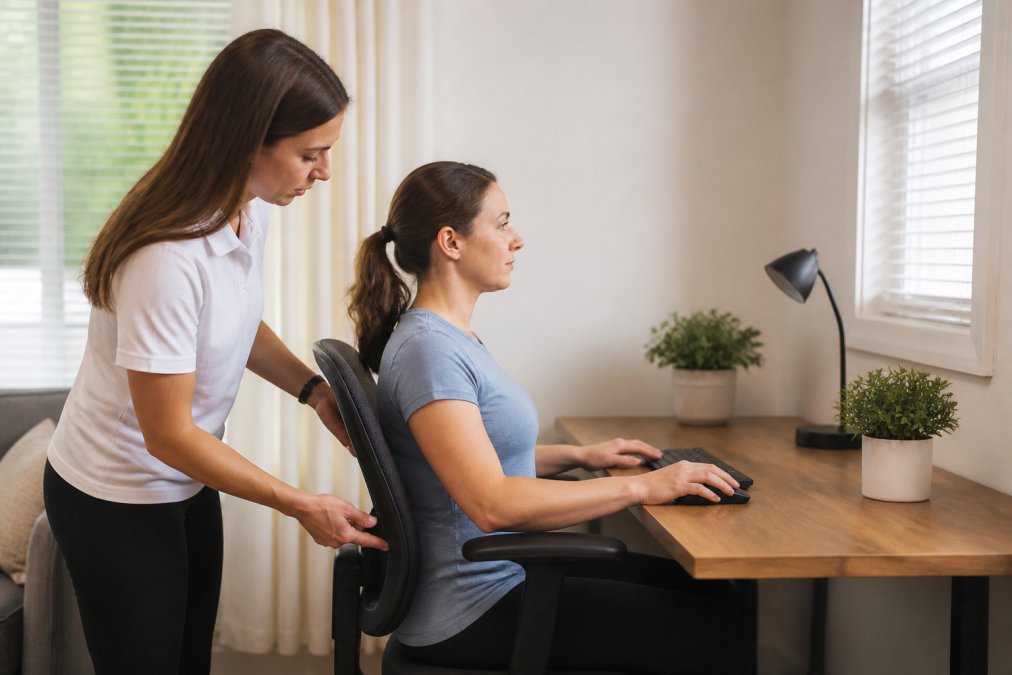
Ergonomic Setup for Neutral Spine Positioning
Monitor height. Your screen should be at eye level. The top should be at or slightly below eye level; your gaze should travel downward at a 15-20 degree angle.
Chair support. Your chair should support the natural curve of your lower back. Your feet should rest flat on the floor, and your elbows should bend at roughly 90 degrees when typing.
Desk organization. Keep frequently used items at elbow height directly in front of you. Use a headset or speakerphone rather than cradling the phone between your ear and shoulder.
Keyboard and mouse placement. Your keyboard and mouse should be at the same height, with your wrists in a neutral (straight) position.
Stress-Aware Movement Breaks and Tension Release
Ergonomics prevent new tension, but stress triggers muscle contraction regardless of posture. Tension awareness and release during the workday catches stress-induced tightness before it develops into a headache.
Targeted Stretching Routine (5 minutes, 2-3 times daily)
Simple neck stretches performed regularly prevent tension buildup. Perform these slowly and gently, never bounce or force a stretch.
- Neck tilts: Slowly tilt your right ear toward your right shoulder. Hold for 15-20 seconds. You should feel a gentle stretch on the left side of your neck. Repeat on the left side. Do 3 sets on each side.
- Chin tucks: Pull your chin straight back, creating a slight double-chin. Hold for 5 seconds. This strengthens postural muscles and counteracts forward head posture. Do 10 reps, 2-3 times daily.
- Shoulder rolls: Roll your shoulders backward slowly, 10 times. Then forward, 10 times. This releases upper trapezius tension and improves shoulder mobility.
- Neck rotation: Slowly turn your head to look over your right shoulder. Hold for 15-20 seconds. Repeat on the left. Do 3 sets on each side.
Stress Boundary Setting and Workload Management
Ergonomics and stretching address the physical expression of stress, but stress itself must be managed to prevent nervous system activation that maintains baseline muscle tension.
Integration: Why Ergonomics + Stress Management Work Together
Ergonomic setup prevents structural stress on your spine and muscles. Stress-management practices (breathing, movement breaks, tension awareness) prevent your nervous system from triggering sustained muscle contraction. Together, they address both the mechanical and neurological drivers of stress headaches.
Start with one practice: either hourly tension check-ins or box breathing. Once that becomes automatic (usually 2-3 weeks), add stretching. Adding everything at once creates overwhelm, which defeats the purpose. Small, consistent practices beat ambitious plans you abandon.
Safety Considerations and When to Seek Professional Care
Seek medical attention first if you experience:
- Sudden, severe headache unlike any you've had before
- Headache with fever, stiff neck, confusion, or vision changes
- Headache after a head injury or accident
- Progressive worsening despite treatment
- Numbness or tingling in your arms or hands
Contraindications to spinal manipulation include:
- Severe osteoporosis or bone disease
- Spinal cord compression
- Certain types of arthritis affecting the spine
- Recent spinal surgery
Family Chiropractic Plus evaluates your full health history and creates personalized treatment plans addressing your specific needs.
American Chiropractic Association clinical guidelines on cervicogenic headaches
Frequently Asked Questions
Can a chiropractor help with stress headaches?
Yes. Chiropractors address stress headaches by treating the musculoskeletal causes underlying them. Stress often creates neck tension and postural misalignment that trigger headaches. Through spinal manipulation, myofascial release, and ergonomic assessment, chiropractic care reduces the physical tension contributing to pain. Many patients experience significant relief after a series of adjustments combined with postural correction strategies.
How long does headache relief last after chiropractic treatment?
Relief duration varies by individual and depends on the underlying cause. Some patients experience immediate relief lasting hours or days after an adjustment. Others see cumulative benefits over several weeks of treatment. For chronic stress headaches, ongoing preventative maintenance, typically monthly visits, helps sustain relief. The duration increases as patients improve posture and manage stress, reducing headache frequency and intensity over time.
What chiropractic adjustment benefits should I expect?
Chiropractic adjustments improve spinal function, reduce neck tension, and restore range of motion in the cervical spine. These changes decrease pain intensity and frequency. Beyond headache relief, patients often report better sleep, reduced muscle stiffness, and improved overall well-being. Evidence-based care focuses on addressing the root cause rather than temporary symptom masking, supporting long-term chronic pain management and preventative health.
Is neck pain normal after a chiropractic adjustment?
Mild soreness or stiffness for 24-48 hours after an adjustment is common as muscles adapt. However, sharp pain or severe discomfort is not normal. A qualified chiropractor will explain what to expect and monitor your response. If pain persists or worsens, contact your provider immediately. This is why a patient-centered approach and clear communication with your chiropractor are essential before and after treatment.